DonateMembershipVisit Heritage
  • Tūrangawaewae
    Places
  • Tira Māori
    Māori Heritage
  • Poutairangahia
    Archaeology
  • Rauemi
    Resources
  • Mō Tātou
    About Us
  • New Zealand Heritage List
  • Nominate and submit
  • Explore the List
  • National Historic Landmarks
  • Plaques
  • Rainbow List Project
  • Lost heritage
  • Visit Heritage
  • Our properties
  • Turnbull House Project
  • Collections
  • Shop
  • Tohu Whenua
  • Tira Māori
  • Conserving Māori heritage
  • Marae built heritage
  • Māori heritage on the List
  • Hinemihi—Te Hokinga Mai
  • What is archaeology?
  • Is there a site on my property?
  • What are my legal requirements?
  • Affecting an archaeological site
  • Declaring an archaeological site
  • Archaeology FAQs
  • Archaeology Digital Library
  • Archaeology guidelines and templates
  • Resources
  • Funding
  • Publications
  • Sustainable management guides
  • Disaster recovery
  • Podcasts & digital resources
  • Education Hub
  • Conservation plans
  • About
  • Board
  • Māori Heritage Council
  • Senior Staff
  • Offices
  • Contact us
  • Careers
  • Covenants
  • Fast-track
  • Corporate documents
  • Currently consulting on
  • Our submissions
  • News
  • Covid-19 response
Quick links
Rārangi Kōrero | The List
Explore the List
National Historic Landmarks
Ngā Manawhenua o Aotearoa me ōna Kōrero Tūturu
Quick links
Tapuwae
A Vision for Places of Māori Heritage
Funding for Māori Heritage
Resources
Quick links
Archaeological Authority Portal
Applying for an archaeological authority
Archaeology FAQs
Browse the most frequently asked questions about archaeological authorities and the archaeological process.
Quick links
Quick links
News
News Keep up to date with Heritage New Zealand Pouhere Taonga
Membership
Membership Find out more and sign up today
DonateMembershipVisit Heritage
  • Tūrangawaewae
    Places
  • Tira Māori
    Māori Heritage
  • Poutairangahia
    Archaeology
  • Rauemi
    Resources
  • Mō Tātou
    About Us
  • New Zealand Heritage List
  • Nominate and submit
  • Explore the List
  • National Historic Landmarks
  • Plaques
  • Rainbow List Project
  • Lost heritage
  • Visit Heritage
  • Our properties
  • Turnbull House Project
  • Collections
  • Shop
  • Tohu Whenua
  • Tira Māori
  • Conserving Māori heritage
  • Marae built heritage
  • Māori heritage on the List
  • Hinemihi—Te Hokinga Mai
  • What is archaeology?
  • Is there a site on my property?
  • What are my legal requirements?
  • Affecting an archaeological site
  • Declaring an archaeological site
  • Archaeology FAQs
  • Archaeology Digital Library
  • Archaeology guidelines and templates
  • Resources
  • Funding
  • Publications
  • Sustainable management guides
  • Disaster recovery
  • Podcasts & digital resources
  • Education Hub
  • Conservation plans
  • About
  • Board
  • Māori Heritage Council
  • Senior Staff
  • Offices
  • Contact us
  • Careers
  • Covenants
  • Fast-track
  • Corporate documents
  • Currently consulting on
  • Our submissions
  • News
  • Covid-19 response
Quick links
Rārangi Kōrero | The List
Explore the List
National Historic Landmarks
Ngā Manawhenua o Aotearoa me ōna Kōrero Tūturu
Quick links
Tapuwae
A Vision for Places of Māori Heritage
Funding for Māori Heritage
Resources
Quick links
Archaeological Authority Portal
Applying for an archaeological authority
Archaeology FAQs
Browse the most frequently asked questions about archaeological authorities and the archaeological process.
Quick links
Quick links
News
News Keep up to date with Heritage New Zealand Pouhere Taonga
Membership
Membership Find out more and sign up today
  • Nominate and submit
  • National Historic Landmarks
  • Nominate and submit
  • National Historic Landmarks
  • Conserving Māori heritage
  • Marae built heritage
  • Conserving Māori heritage
  • Marae built heritage
  • Archaeological authorities
  • Archaeology Digital Library
  • Archaeological authorities
  • Archaeology Digital Library
  • All resources
  • Publications
  • Funding
  • All resources
  • Publications
  • Funding
  • FAQs
  • FAQs
Follow us on:
Places
  • Nominate and submit
  • National Historic Landmarks
Tira Māori
  • Conserving Māori heritage
  • Marae built heritage
Archaeology
  • Archaeological authorities
  • Archaeology Digital Library
Resources
  • All resources
  • Publications
  • Funding
FAQs
  • FAQs
Follow us on
HomePrivacyTerms and conditionsAbout this site
© Heritage New Zealand Pouhere Taonga 2026.
 
Manganuku Bridge

Waioeka Road (State Highway 2), Waioeka Gorge, WAIRATA

Public

Historic Place Category 2

List No. 7197

Quick links:
List GalleryLocationDetails
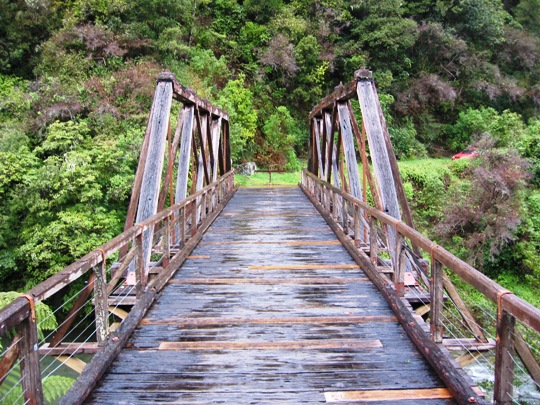
The Manganuku Bridge is a rare surviving example of a Howe truss bridge, and is located in the scenic Waioeka Valley, near Opotiki. Probably erected in 1928-1929, the timber structure was part of a major roadmaking effort in the valley, providing a shorter route between the Bay of Plenty and Poverty Bay than that previously used. A route via the Waioeka was discussed in 1914, and became a reality after local settlers petitioned the Minister of Public Works, Gordon Coates (1878-1943) in June 1920. As well as providing better communications between different parts of the North Island, the new road was to improve access to farms in the Upper Waioeka. Established from 1911, these marginal holdings consisted mostly of sheep runs, which had been offered by ballot to small-scale farmers as part of government efforts to expand agricultural production in the back blocks. Road construction was also a valuable source of income for settlers who struggled to make a living from farming due to poor-quality soil, high rainfall and difficult terrain. Early roadbuilding took place using picks and shovels, although shortly before the Manganuku Bridge was built, pneumatic drills and tractors were introduced.

Located some distance from the nearest substantial settlement, the bridge at Manganuku was among the last to be built along the route. It was erected across the Manganuku Stream, which was one of the many watercourses in the Waioeka Gorge to be traversed. Replacing an earlier structure of swing-bridge type, the bridge lay next to a school site on the southern side of the river, and a homestead belonging to the Gibson family on the opposite bank. The Gibsons farmed approximately 809 hectares (2,000 acres) in the Manganuku Valley from 1919. Probably following the bridge's completion, the first service car ran from Gisborne to Opotiki through the Waioeka in late 1929.

The bridge was designed and built by the Public Works Department (PWD), using Australian hardwood timber. Accommodating a road 4.7 m wide, it consisted of a 9.5 m land span of rolled steel joists and a modified Howe truss span of 24.8 m sitting on a concrete pier and abutments. Howe trusses combined timber technology with the use of metal by employing timber diagonals for compression and vertical iron or steel rods for tension. This method was patented in the USA in 1840, where it was particularly employed in the construction of railway bridges. With the widespread adoption of timber technology in New Zealand, it became a common means of bridge construction, with standard features developed by the PWD in the 1880s. It was widely used until the 1930s, with the Manganuku Bridge being a comparatively late example.

The bridge occupied a solitary position on the road after the Gibson family abandoned their homestead in 1934, and was superseded by a new structure a short distance downstream some thirty years later, when the Waioeka Road was widened and improved. Recognised as historically significant, it was repaired in 1992 with the help of the Institution of Professional Engineers New Zealand (IPENZ) after being in danger of complete collapse. It currently enables foot traffic to access the Manganuku Track in the Waioeka Gorge Scenic Reserve.
The Manganuku Bridge is a rare surviving Howe truss bridge in New Zealand, with most other examples having been lost through decay or demolition. It reflects a once-common engineering tradition and vernacular carpentry skills, from a time when timber technology was widely employed. The bridge is significant for its association with the expansion of New Zealand's road network in the 1920s, and the specific improvement of communications between the Bay of Plenty and Poverty Bay. It is also connected with farming history, and government settlement policies in the early 1900s. The bridge occupies a scenic location, with public access from State Highway 2. It is associated with a broader historical and archaeological landscape, which includes remnants of its approach roads. It is one of at least two bridges in the Waioeka Valley of recognized heritage significance.
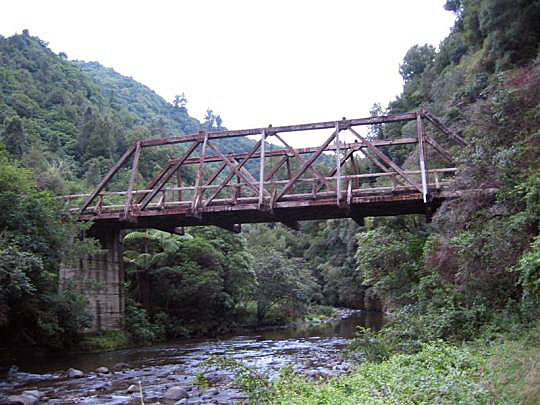
Manganuku Bridge, Waioeka | Martin Jones | 03/04/2003 | Heritage New Zealand
Manganuku Bridge, Waioeke | Martin Jones | 03/04/2003 | Heritage New Zealand
Manganuku Bridge, Waioeka | Martin Jones | 03/04/2003 | Heritage New Zealand
Manganuku Bridge, Waioeke | Martin Jones | 03/04/2003 | Heritage New Zealand

List Entry Information

Overview

Status
Listed

List Entry Status
Historic Place Category 2

Access
Able to Visit

List Number
7197

Date Entered
23rd June 1994

Date of Effect
23rd June 1994

City/District Council
Ōpōtiki District

Region
Bay of Plenty Region

Legal description

Secs 1-2 SO 8631 (NZ Gazette 1993, p.872) and Manganuku Stream, Gisborne Land District

Detailed List Entry

Construction Professional

Name

Public Works Department

Type

Architect

Biography

No biography is currently available for this construction professional

Name

Public Works Department

Type

Architect

Biography

No biography is currently available for this construction professional

Construction Details

Start Year

1928

Finish Year

1929

Type

Original Construction

Start Year

1992

Type

Modification

Description

Major repairs to superstructure

Reference

Completion Date

27th June 2007

Report Written By

Martin Jones and Shirley Arabin

Information Sources

Appendices to the Journals of the House of Representatives (AJHR)

Appendices to the Journals of the House of Representatives

Cochran, 1991

Chris Cochran, 'Manganuku Bridge, Waioeka Valley: Maintenance Survey', [Gisborne], 1991 (copy held by NZHPT, Auckland)

Nelson, 1994

Wayne Nelson, 'Manganuku Bridge: Architectural Assessment', unpublished report for NZHPT, Wellington, 1994 (copy held by NZHPT, Auckland)

Spencer, 1992

Margaret Spencer, The Waioeka Pioneering Saga, Gisborne, 1992

Thornton, 2001

Geoffrey Thornton, Bridging the Gap, Early Bridges in New Zealand 1830-1939, Auckland, 2001

Report Written By

This place was identified as significant under previous legislation with different information requirements. It remains significant under the current legislation. There is opportunity under our legislation and policies to add to this information. Further information about this place may be available from the Lower Northern Office of Heritage New Zealand Pouhere Taonga. Please note that entry on the New Zealand Heritage List/Rarangi Korero identifies only the heritage values of the property concerned, and should not be construed as advice on the state of the property, or as a comment of its soundness or safety, including in regard to earthquake risk, safety in the event of fire, or insanitary conditions.

Further Information

Current Usages

Uses: Transport

Specific Usage: Bridge/ Viaduct

Former Usages

General Usage:: Transport

Specific Usage: Bridge/ Viaduct

Themes

Web Links

description: IPENZ Engineering Heritage

url: http://www.ipenz.org.nz/heritage/itemdetail.cfm?itemid=89

Overview

Status

Listed

List Entry Status

Historic Place Category 2

Access

Able to Visit

List Number

7197

Date Entered

23rd June 1994

Date of Effect

23rd June 1994

City/District Council

Ōpōtiki District

Region

Bay of Plenty Region

Legal description

Secs 1-2 SO 8631 (NZ Gazette 1993, p.872) and Manganuku Stream, Gisborne Land District

Status

Listed

List Entry Status

Historic Place Category 2

Access

Able to Visit

List Number

7197

Date Entered

23rd June 1994

Date of Effect

23rd June 1994

City/District Council

Ōpōtiki District

Region

Bay of Plenty Region

Legal description

Secs 1-2 SO 8631 (NZ Gazette 1993, p.872) and Manganuku Stream, Gisborne Land District

Construction Information

Construction Professional

Name

Public Works Department

Type

Architect

Biography

No biography is currently available for this construction professional

Name

Public Works Department

Type

Architect

Biography

No biography is currently available for this construction professional

Construction Details

Start Year

1928

Finish Year

1929

Type

Original Construction

Start Year

1992

Type

Modification

Description

Major repairs to superstructure

Construction Professional

Name

Public Works Department

Type

Architect

Biography

No biography is currently available for this construction professional

Name

Public Works Department

Type

Architect

Biography

No biography is currently available for this construction professional

Construction Details

Start Year

1928

Finish Year

1929

Type

Original Construction

Start Year

1992

Type

Modification

Description

Major repairs to superstructure

Reference

Historical and Associated Iwi / Hapū / Whānau

Completion Date

27th June 2007

Report Written By

Martin Jones and Shirley Arabin

Information Sources

Appendices to the Journals of the House of Representatives (AJHR)

Appendices to the Journals of the House of Representatives

Cochran, 1991

Chris Cochran, 'Manganuku Bridge, Waioeka Valley: Maintenance Survey', [Gisborne], 1991 (copy held by NZHPT, Auckland)

Nelson, 1994

Wayne Nelson, 'Manganuku Bridge: Architectural Assessment', unpublished report for NZHPT, Wellington, 1994 (copy held by NZHPT, Auckland)

Spencer, 1992

Margaret Spencer, The Waioeka Pioneering Saga, Gisborne, 1992

Thornton, 2001

Geoffrey Thornton, Bridging the Gap, Early Bridges in New Zealand 1830-1939, Auckland, 2001

Other Information

This place was identified as significant under previous legislation with different information requirements. It remains significant under the current legislation. There is opportunity under our legislation and policies to add to this information. Further information about this place may be available from the Lower Northern Office of Heritage New Zealand Pouhere Taonga. Please note that entry on the New Zealand Heritage List/Rarangi Korero identifies only the heritage values of the property concerned, and should not be construed as advice on the state of the property, or as a comment of its soundness or safety, including in regard to earthquake risk, safety in the event of fire, or insanitary conditions.

Historical and Associated Iwi / Hapū / Whānau

Completion Date

27th June 2007

Report Written By

Martin Jones and Shirley Arabin

Information Sources

Appendices to the Journals of the House of Representatives (AJHR)

Appendices to the Journals of the House of Representatives

Cochran, 1991

Chris Cochran, 'Manganuku Bridge, Waioeka Valley: Maintenance Survey', [Gisborne], 1991 (copy held by NZHPT, Auckland)

Nelson, 1994

Wayne Nelson, 'Manganuku Bridge: Architectural Assessment', unpublished report for NZHPT, Wellington, 1994 (copy held by NZHPT, Auckland)

Spencer, 1992

Margaret Spencer, The Waioeka Pioneering Saga, Gisborne, 1992

Thornton, 2001

Geoffrey Thornton, Bridging the Gap, Early Bridges in New Zealand 1830-1939, Auckland, 2001

Other Information

This place was identified as significant under previous legislation with different information requirements. It remains significant under the current legislation. There is opportunity under our legislation and policies to add to this information. Further information about this place may be available from the Lower Northern Office of Heritage New Zealand Pouhere Taonga. Please note that entry on the New Zealand Heritage List/Rarangi Korero identifies only the heritage values of the property concerned, and should not be construed as advice on the state of the property, or as a comment of its soundness or safety, including in regard to earthquake risk, safety in the event of fire, or insanitary conditions.

Further Information

Current Usages

Uses: Transport

Specific Usage: Bridge/ Viaduct

Former Usages

General Usage: Transport

Specific Usage: Bridge/ Viaduct

Web Links

description: IPENZ Engineering Heritage

url: http://www.ipenz.org.nz/heritage/itemdetail.cfm?itemid=89

Current Usages

Uses: Transport

Specific Usage: Bridge/ Viaduct

Former Usages

General Usage: Transport

Specific Usage: Bridge/ Viaduct

Web Links

description: IPENZ Engineering Heritage

url: http://www.ipenz.org.nz/heritage/itemdetail.cfm?itemid=89

Location

Loading
Stay up to date with Heritage this month